
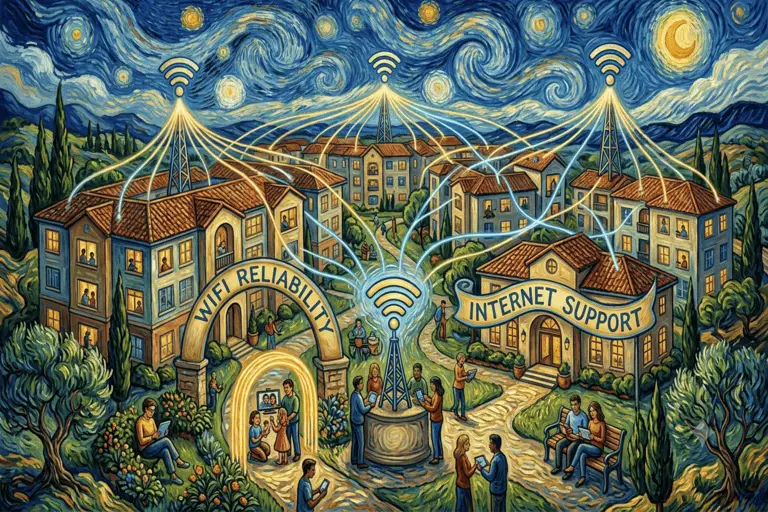
How Improving WiFi Reliability Can Reduce Internet Support Issues in Multifamily Communities
Reliable WiFi connectivity has become an indispensable component of modern apartment living. Residents rely on it for remote work, streaming video services, online education, communication with smart-home devices and everyday activities; when it performs inconsistently, they’re more likely to reach out for assistance from property teams.
Multifamily operators face the additional difficulty of dealing with resident complaints, technical inquiries and service requests related to WiFi connectivity in multifamily communities. Finding ways to improve WiFi reliability multifamily communities can therefore benefit both residents and property staff.
Reliable networks don’t simply mean faster internet; they require appropriate network design, sufficient capacity, consistent coverage, proactive monitoring and an efficient support process – elements which must all work in harmony to provide residents with an excellent connectivity experience while decreasing support activity. When combined, apartment communities can achieve improved connectivity while simultaneously decreasing support activity costs.
Why WiFi Reliability Is Critical in Multifamily Communities
Apartment buildings present unique connectivity challenges. Multiple units may share close quarters, residents may use numerous connected devices, and building materials can reduce wireless signals.
A property may also include shared spaces, including:
Lobbies, fitness centers, clubhouses, business centers, pool areas, outdoor common areas and Leasing offices (leasable), leasing offices (leasing offices) and community rooms – residents expect connectivity in all the places where they reside and spend their time.
Poor WiFi reliability can result in slow speeds, dropped connections, weak coverage or difficulty connecting devices; quickly becoming resident complaints.
Improving network reliability for property managers can create a more predictable resident experience.
Common Causes of WiFi Issues in Apartment Communities
Before improving WiFi performance, operatorss must gain an understanding of what causes connectivity issues.
Modern households may contain numerous connected devices, including smartphones, laptops, televisions, tablets, gaming systems cameras speakers and smart home devices.
When multiple devices compete for network resources, performance can deteriorate rapidly if the network was not tailored specifically for its usage requirements on the property.
Poor Coverage: Wireless signals may be affected by walls, floors, doors, elevators, concrete structures and metal structures, as well as other building materials that obstruct their path.
Networks that perform well in one area may fail in another due to improper placement of access points.
Network Capacity Issue
As resident Internet usage rises, network capacity must follow suit. A network designed for older usage patterns may struggle to accommodate high-bandwidth apps that demand high capacities such as 4G LTE.
Interference: Multiple wireless networks and electronic devices may contribute to interference. In densely populated apartment buildings, several wireless networks may operate nearby.
Unsupported Equipment
Outdated networking equipment may no longer support today’s wireless standards, traffic volumes or security requirements. A regular technology assessment can help operators determine whether their infrastructure should be upgraded.
1. Conduct an Accurate Network Assessment.
An assessment can identify coverage gaps, capacity limitations, equipment issues and regions experiencing persistent connectivity problems.
Operators must assess:
Wireless coverage, access point placement, network capacity and device density requirements, as well as bandwidth requirements, will serve as a basis for making informed network improvements rather than simply responding to resident complaints.
2. Determine WiFi Coverage Within Your Property
Every multifamily community is designed differently.
An effective network should take into account factors like unit count, building construction type, common areas usage patterns and device density expectations among its constituents.
Appropriate placement of access points can create more uniform coverage and help to minimize areas where residents experience weak signals.
3. Keep Track of Network Performance
Proactive monitoring can assist networks in detecting issues before they lead to widespread resident complaints.
Monitoring can provide insight into:
Connection quality, Network availability, Capacity utilization, Equipment health, and traffic patterns and performance changes are among the primary drivers for connectivity problems that recur over time.
Property operators and network teams can quickly identify potential problems within a network by monitoring network data. Rather than wait for residents to report every concern, these teams can take proactive steps by looking through this data for potential issues that need attention.
Reducing Internet Support Tickets in Apartments
One of the greatest advantages of reliable WiFi for apartments is reducing internet support tickets generated.
Residents experiencing connectivity issues may reach out to their leasing office, property manager, or support team for help. A single recurring network issue could generate multiple requests from residents at different addresses.
For example, when WiFi coverage in one section of a building is poor, multiple residents may independently report similar problems to the property team without realizing there may be an underlying infrastructure issue that needs addressing. Without central network monitoring in place, this issue may remain ignored and treated as separate incidents rather than recognized for what it truly is: an infrastructure problem.
Recognizing and solving the source of an issue can help reduce repeated support requests.
Improve Resident Support Process
Network reliability is only one aspect of reducing support activity; residents also require an effective means to get help when problems arise.
An effective support process should provide answers to:
- Where residents should report technical issues
- What information should be submitted
- Tracking support requests
- When residents can expect updates
- Who handles network-related problems
- How outage notifications are communicated to residents
Clear processes help residents avoid repeatedly reaching out to onsite staff about the same issue.
Preventative Maintenance: Delaying proactive maintenance can save time and trouble should any equipment break.
Regular Maintenance can include:
Reviewing Equipment Performance, Updating Network Equipment, Checking Access Point Health, Reviewing Capacity Requirements and Evaluating Coverage Needs, as well as Replacing Old Hardware, are essential in order to optimize equipment performance, manage capacity requirements and evaluate coverage effectively.
Proactive maintenance can help operators identify potential issues before they pose serious threats to residents.
Consider Managed WiFi Solutions for Multifamily Communities
Managing a large WiFi network requires technical knowledge, monitoring equipment effectively and ongoing maintenance.
Managed WiFi services offer centralized network administration and technical support services that meet your unique solution’s requirements, from monitoring networks to configuration management, troubleshooting, performance analysis, and security administration. Equipment support services are provided in one package.
Multifamily operators may benefit from managed services to alleviate some of the technical burden on onsite property teams.
Maintaining consistent network standards among multiple properties can otherwise prove challenging. This solution provides an effective solution.
Standardizing WiFi Network Across Multifamily Properties
Portfolio operators can benefit greatly from creating network standards.
Standardization may offer protection in these areas:
Equipment specifications, network configurations, security requirements, as well as monitoring procedures and support processes, should be documented and performance expectations defined prior to deployment or upgrading connectivity at new properties. This ensures a repeatable approach when installing or upgrading connectivity at these properties.
Operators tasked with managing communities across different markets may benefit from adopting a uniform strategy to make network management more uniform while still accommodating property-specific requirements.
Use Support Data to Recognize Network Problems
Support tickets provide valuable insight into network performance.
Instead of viewing each ticket as an isolated incident, operators can identify patterns.
Example questions may include: (for tickets concentrated in one building) Are specific floors affected? Do problems happen at specific times? Are residents reporting similar symptoms; investigating devices; are complaints growing over time?
These patterns can help identify whether the problem lies with coverage, capacity, equipment, configuration or another factor.
Reliability Can Enhance Resident Experience
Internet connectivity has quickly become a key amenity of apartment living. Reliable networks can increase resident satisfaction by making digital activities simpler.
Residents expect to be able to work remotely, attend virtual meetings, stream content to smart devices and communicate online without constantly needing to troubleshoot their connection.
Improving network reliability can contribute to an easier living experience overall.
Conclusion
Enhancing WiFi reliability within multifamily communities depends on more than simply increasing internet speed; operators must also consider network design, coverage, capacity, equipment monitoring, maintenance, resident support and much more when making decisions on how best to improve it.
Proactive approaches can help identify connectivity issues before they spread and reduce repeated internet support tickets apartments experience WiFi issues in apartments.
Multifamily operators should aim for a robust, scalable, and efficiently run network capable of meeting modern resident expectations while decreasing operational workload. By pairing proper infrastructure with proactive monitoring processes and clear support processes, apartment communities can create stronger connectivity experiences for residents as well as property teams alike.
Frequently Asked Questions
1. How can multifamily communities improve WiFi reliability?
Multifamily communities can improve WiFi reliability by assessing network coverage, optimizing access point placement, increasing capacity where needed, upgrading outdated equipment, monitoring performance, and performing proactive maintenance.
2. Why do apartments generate many internet support tickets?
Apartments can generate internet support tickets because of weak WiFi coverage, network congestion, equipment problems, outages, device connectivity issues, and insufficient network capacity.
3. Can managed WiFi reduce internet support tickets?
Managed WiFi can help reduce support tickets by providing proactive monitoring, centralized network management, troubleshooting, performance visibility, and ongoing technical maintenance.
4. How does network monitoring improve apartment WiFi?
Network monitoring provides visibility into connectivity, equipment health, capacity, and performance. It can help technical teams identify potential problems before they result in widespread resident complaints.
5. What should multifamily operators consider when upgrading WiFi?
Operators should consider property layout, building materials, resident density, device usage, bandwidth requirements, access point placement, network security, scalability, monitoring, and ongoing support needs.